

HCGEC 2027
THE COMPLETE GUIDE
This manual covers everything you need to prepare, participate, and submit successfully. Scroll down to find it all, from timelines and prompts to bootcamps and recordings.
Table of Contents
Harvard Crimson Global Essay Competition
A fully virtual writing challenge for motivated middle and high school students around the world.
Many students mistakenly believe that competitions are only for experts. However, the Harvard Crimson Global Essay Competition (HCGEC) is a global, virtual essay contest designed for both beginners and experts. More than just a competition, it's a comprehensive learning experience. Participants gain free access to pre-recorded webinars that teach essential skills for success.
Now in its 6th year, HCGEC is hosted through a joint collaboration between Crimson Education, Crimson Rise and The Harvard Crimson. Last year, we welcomed over 10,000+ students from 140+ countries, and we're excited for the journey that lies ahead for you!
You can view last year’s winning submissions here.
Introduction
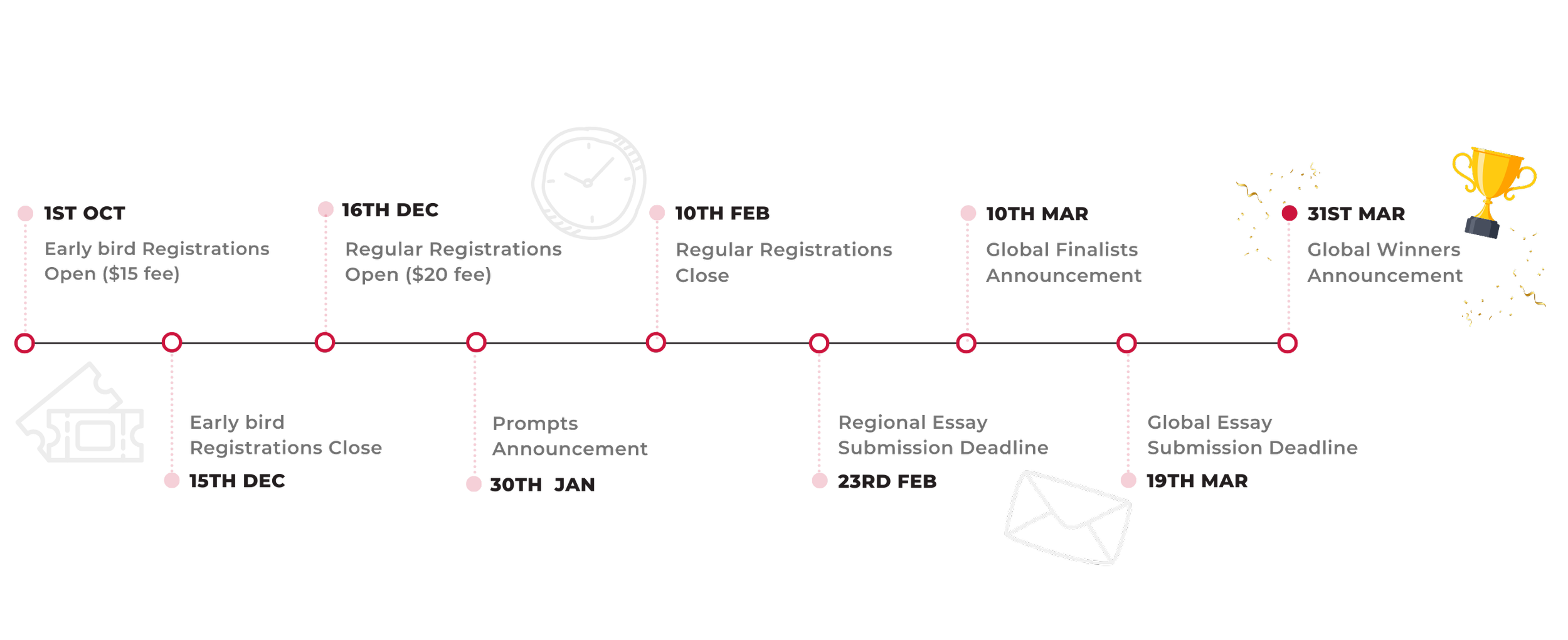
Key DATES
All deadlines are 23:59 (GMT+0) on dates specified below.
Learning Resources
HCGEC 2026 Bootcamps
Bootcamps Topics
Module 1 : What’s an Essay?
LECTURE 1: Explaining Different Writing Styles
LECTURE 2: Components of a Strong Essay
LECTURE 3: The Importance of Topic Selection
Module 2 : Introduction to Creative Writing
LECTURE 4: The Elements of Creative Writing
LECTURE 5: Writing Prompts and Exercises for Creativity Enhancement
LECTURE 6: Crafting Engaging and Unique Narratives

Module 3 : An Introduction to Argumentative Writing
LECTURE 7: Structure and Components of Argumentative Essays
LECTURE 8: Formulating Strong Arguments and Counter arguments
LECTURE 9: Understanding and Utilizing Persuasive Language in Argumentative Writing
Module 4 : An Introduction to
Journalistic Writing
LECTURE 10: Techniques for Long-form Storytelling
LECTURE 11: Investigative Journalism and In-depth Reporting
LECTURE 12: Ethical Considerations in Narrative Journalism
Module 5 : Final Touches &
Formatting
LECTURE 13: Essay Submission Ready Guidelines
and Techniques
Live Webinars

for College Applications
Essays That Get Accepted : Writing
how to make your application essays shine.
Discover what admissions officers look for and

8th March 2026

9 AM EST | 3 PM CET | 7.30 PM IST

Online

Finding Your Personal Voice
Through Writing
Learn secrets by a Harvard Leader to master
essay strategies that win.
17th January 2026
9 AM EST | 3 PM CET | 7.30 PM IST
Online

Persuade With Power : Strategies
for Effective Arguments
Master the art of persuasion and write essays
that make an impact.
8th February 2026
9 AM EST | 3 PM CET | 7.30 PM IST
Online

Unleashing Imagination : The Art
of Creative Writing
unleash your creative potential.
Learn how to craft compelling stories and
7th February 2026
9 AM EST | 3 PM CET | 7.30 PM IST
Online

Journalistic Pieces
Truth in Words : Crafting Impactful
Understand what makes journalistic writing
stand out and how to write with precision.
15th February 2026
9 AM EST | 3 PM CET | 7.30 PM IST
Online
ESSAY Prompts



PROMPT SELECTION
Each participant will select one prompt from any one of the categories ( creative, argumentative, or journalistic) below.
The submission form will be shared with all the registered participants once registrations close on 10th February.
CREATIVE
Choose a character from a book, movie, or TV show of your choice. Imagine this character wakes up on a planet not yet discovered by humans. Craft a descriptive story about how the character manages to make it back to Earth.
A door appears in your home that wasn't there before. It leads to a version of your life where you made a different choice in the past. You can visit, but you cannot stay. What do you find?
Write from the perspective of an object that has witnessed three generations of a family. What has it seen that the family themselves have forgotten or never knew?
ARGUMENTATIVE
Should elite universities prioritise merit or racial equity in admissions decisions? Argue which leads to a fairer society.
Is talent or effort more important in achieving success? Use examples from education, sports, or well-known figures to compare natural ability and perseverance.
Should voting be mandatory in democratic societies? Argue whether compulsory participation strengthens or undermines the integrity of democracy.
JOURNALISTIC
Examine how youth—either today or at earlier moments in history—have reshaped an industry. Explore the challenges the individual/group faced and the lasting impact of their innovative approaches.
Investigate how a public space in your area (a park, library, community center, etc.) has changed over time. What does its evolution reveal about the people who use it and the forces shaping your community?
Examine how a school, workplace, or institution in your community is rethinking mental health support. What's working, what's missing, and who is leading the change?
REGIONAL SUBMISSION
The regional qualifying submission has a maximum length of 500 words. The top 5 creative, top 5 argumentative, and top 5 journalistic
essays from each region will be invited to the Global Final.
View the detailed guidelines here
JUDGING RUBRIC
Click here to view the Judging Rubrics for the HCGEC 2026 here
Regional QUALIFIERS
Submit a 500-word essay in response to your chosen prompt.
Choose from three tracks: creative, argumentative or journalistic.
Submit as a Word Document via the submission link that will be provided to registrants.
All participants will be invited to exclusive bootcamps hosted by top professionals and professors.
Top 30 essays per region (10 per track) will advance to the Global Finals.
SUBMISSION
Guidelines
The following guidelines cover the general rules on submissions, which are relevant to the regional and global rounds. More detailed guidelines will be sent to each participant’s registered email.
GENERAL
Open to students aged 10 -18 worldwide
Essays must be written in English
Each participant may submit one entry only
Choose one prompt from one category
Must respond to an official prompt from one of three categories:
Creative
Argumentative
Journalistic
Max 500 words (excluding citations, title and student name)
Submission must be in Word document format (.doc) – Google Docs or Drive links will not be accepted
Use Times New Roman size 11 with 1.5 spacing
All submissions must be original work – entries will be screened for plagiarism and AI use
FIRST PAGE REQUIREMENTS
The first page of your submission must have the following information:
Full name
Essay category (creative, argumentative, or journalistic)
Chosen prompt
The competition region you’re from
North America
LATAM
APAC (includes East Asia, Southeast Asia, Oceania)
Middle East, Africa, Russia
Europe and Central Asia
NAMING DIRECTIONS
Please follow these guidelines when naming your submission document:
Start with the number of your chosen prompt (1, 2 or 3) as listed in the submission form
Add ‘_creative’, ‘_argumentative’ or ‘journalistic’ based on your selected essay category
End with your surname
For example, if Jane Doe selects prompt 2 in the creative category, the file name should be: ‘2_Creative_Doe’
Kazakhstan participants can submit their essays here