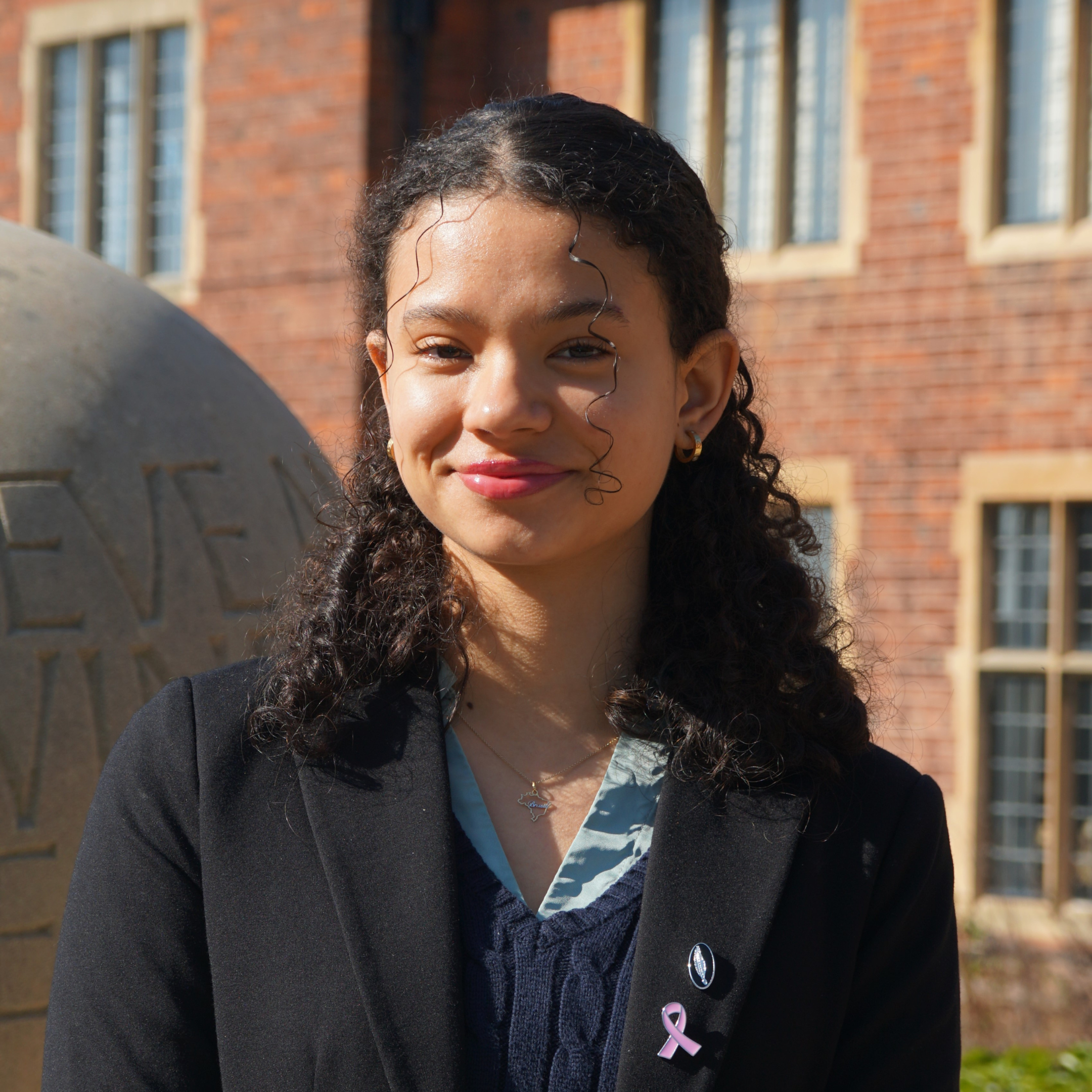
YISI LIU
China
Inside a Library That Is No Longer Public
Once a hub for open debate, the Fude Library at Beijing’s Dongsi Mosque has become a restricted forum—revealing how access to knowledge can quietly narrow.
Tucked inside Beijing’s commercial districts, Dongsi Mosque houses a library that once drew scholars into lively debate but, in 2017, reopened as a government-led platform with defined themes and limited access. The shift did not alter the mosque’s exterior, but it transformed how knowledge circulated within its walls.
The mosque itself remains quiet, austere, and meticulously clean. Red walls and green-tiled roofs enclose a traditional courtyard, where, in summer, the faint hum of cicadas can be heard above the low murmur of footsteps. Along the roofline, small ridge ornaments (mythical creatures common in Chinese architecture) appear subtly altered: their eyes removed, in accordance with Islamic prohibitions against figural representation. The effect is understated but telling, a visual trace of how different cultural traditions have long coexisted within the space. At dusk, worshippers of different backgrounds file in for Maghrib, the evening prayer. For decades, the Fude Library inside functioned as more than a collection of books. It served as an intellectual salon, where scholars, writers, and public figures gathered for open-ended discussions on religion, culture, and society.
That openness is no longer visible. “Despite being called a ‘library,’ the space is no longer open to the public,” said He Tong, one of the chief imams at Dongsi Mosque. The doors remain shut, the shelves inaccessible, and activities that were once informal and dialogic have shifted into closed, structured forums.
The contraction stands in quiet tension with the library’s very name, “Fude,” which carries layered meanings that signify a legacy of exchange between China and the Arab world. Phonetically, it commemorates Fuad I, the former King of Egypt who donated books to Chinese Muslim institutions; semantically, it invokes fude—“fortune and virtue”—a concept rooted in Chinese tradition.
The library was established in 1936 after Ma Songting, one of the Four Great Imams of Modern and Contemporary Chinese Islam, returned from Egypt with a collection of Islamic texts, as documented in Investigations of Mosques in Beijing. Initially serving as the library of Chengda Normal School, a modern institution dedicated to training students versed in both Islamic and Chinese traditions, it expanded access to religious knowledge for a new generation. Built on the southern side of the mosque, the two-story structure housed more than 3,000 volumes in Arabic and Chinese, making it the only Islamic library of its kind in East Asia at the time.
Around it emerged what contemporaries described as the “Fude academic circle,” an informal but influential intellectual network. The library also functioned as a lecture hall, hosting talks that ranged from Islamic culture and Chinese philosophy to ethnic relations and social thought, as recorded in Collection of Fude Works (compilation of research findings from the Fude Library) shared by Imam He. Students from Chengda Normal School, alongside those from leading universities such as Peking University and Tsinghua University, gathered there for discussion and exchange.
According to Collection of Fude Works, the library provided a rare platform where Islamic scholarship intersected with China’s mainstream intellectual life. It was here that scholars debated ideas across disciplines, and where students encountered religious thought not as doctrine alone, but as part of a broader cultural and philosophical conversation.
This intellectual life was interrupted by decades of upheaval beginning in 1937. The Sino-Japanese War, the Chinese Civil War, and later political movements left only fragmentary records of how the library functioned. During these years, faculty and students of Chengda Normal School were displaced across a country at war. The library itself fell silent, its rooms emptied of readers. What had once been a space of open exchange stood largely unused, its shelves intact but its intellectual life suspended.
“The books were moved again and again,” recalled Imam He, describing the turbulent journey of the collection during wartime. Following the outbreak of war in 1937, the library was damaged and temporarily occupied by the Japanese army. Portions of its collection were relocated as Chengda Normal School moved south to Guilin and Chongqing, before returning to Beijing after the war. The movement of the books mirrored the displacement of the people who had once gathered around them.
During the Cultural Revolution, the mosque took on an unusual role. According to Mr. Zhang, a longtime doorkeeper at Dongsi Mosque, it was one of the few mosques in China that continued to function, in part to receive visiting Muslim diplomats. At a time when books and cultural artifacts were being destroyed elsewhere, residents in the surrounding neighborhoods reportedly entrusted books, manuscripts, and cultural artifacts to the mosque for safekeeping—regardless of whether they were related to Islam. Many of these materials remain in the library today, forming an archive shaped as much by preservation under duress as by institutional design.
After prolonged historical silence, display boards inside Dongsi Mosque show that public documentation resumes only in the early 2000s, when renovations began in 2003, followed by systematic cataloguing and restoration between 2014 and 2017.
In 2017, the launch of the Fude Forum was presented as a revival. Yet its positioning had fundamentally changed. Framed as a platform for Sino-Arab exchange, according to the China Religious Studies Network, it was tasked with advancing the Sinicization of Islam and cultivating religious talent aligned with national priorities.
Yang Faming, President of the China Islamic Association, said at the forum’s opening, “The goal is not only to serve as a space of remembrance, but also as a flagship guiding Islamic scholarship toward compatibility with socialist society”—a far cry from the scholar-driven circle formed around open shelves.
Today, while the name of the Fude Library appears in official programs, the physical space remains closed to ordinary readers. The courtyard welcomes worshippers, but institutional narratives redefine the library’s publicness. Researchers seeking access must apply through institutional channels, often limited to digital materials rather than the original collection.
Inside, artifacts and manuscripts that survived decades of upheaval remain preserved but largely unseen. Among them are handwritten Qur’an manuscripts dating back to the Yuan dynasty, incense burners from the Ming era, and thread-bound books from China’s Republican era. Together, they form primary records of cultural and intellectual history that are no longer directly accessible to the public.
For Muslim worshippers, the mosque remains a site of daily ritual and gathering, though no longer a venue for informal intellectual exchange. According to Mr. Ma, a regular worshiper at the mosque, the shift is subtle but consequential: when discussion becomes structured rather than spontaneous, the way believers engage with their tradition inevitably changes.
For younger generations, the distance feels more pronounced. Liu, a young Muslim woman, described her own experience as one of gradual separation. Growing up, her connection to Islam was largely shaped through family practices—dietary restrictions, daily habits—rather than direct engagement with religious texts or scholarship. Access to the deeper intellectual traditions of her faith, she said, has become increasingly limited. Even in spaces like the mosque, which once facilitated such encounters, it is now difficult to trace those origins firsthand.
For those outside the Islamic community, the narrowing of access also carries implications. “The library had offered a rare point of contact between Islamic scholarship and China’s broader intellectual life,” noted Dr. Li Lin from the Institute of World Religions, Chinese Academy of Social Sciences. As access contracted, so did occasions for unscripted dialogue.
Standing outside the locked doors, it becomes clear that public spaces rarely disappear all at once. Instead, they narrow gradually, until participation gives way to spectatorship. The story of the Fude Library is not only about preservation, but about access—about who remains able to enter, and whose voices are no longer part of the conversation.
Works Cited
Beijing Islamic Association and Beijing Islamic Seminary (2017) Collection of Fude Works (Vol. 1). [Unpublished manuscript], pp.1–12.
Institute of World Religions, Chinese Academy of Social Sciences (n.d.) China Religious Studies Network [Website], http://iwr.cass.cn/ (Accessed 22 February 2026).
Liang, X.L. (2014) Investigations of Mosques in Beijing, 1st edn, Beijing: National Library of China Press, pp.11–16.
The Wholeness of a Chip
Inside a Library That Is No Longer Public
Once a hub for open debate, the Fude Library at Beijing’s Dongsi Mosque has become a restricted forum—revealing how access to knowledge can quietly narrow.
Tucked inside Beijing’s commercial districts, Dongsi Mosque houses a library that once drew scholars into lively debate but, in 2017, reopened as a government-led platform with defined themes and limited access. The shift did not alter the mosque’s exterior, but it transformed how knowledge circulated within its walls.
The mosque itself remains quiet, austere, and meticulously clean. Red walls and green-tiled roofs enclose a traditional courtyard, where, in summer, the faint hum of cicadas can be heard above the low murmur of footsteps. Along the roofline, small ridge ornaments (mythical creatures common in Chinese architecture) appear subtly altered: their eyes removed, in accordance with Islamic prohibitions against figural representation. The effect is understated but telling, a visual trace of how different cultural traditions have long coexisted within the space. At dusk, worshippers of different backgrounds file in for Maghrib, the evening prayer. For decades, the Fude Library inside functioned as more than a collection of books. It served as an intellectual salon, where scholars, writers, and public figures gathered for open-ended discussions on religion, culture, and society.
That openness is no longer visible. “Despite being called a ‘library,’ the space is no longer open to the public,” said He Tong, one of the chief imams at Dongsi Mosque. The doors remain shut, the shelves inaccessible, and activities that were once informal and dialogic have shifted into closed, structured forums.
The contraction stands in quiet tension with the library’s very name, “Fude,” which carries layered meanings that signify a legacy of exchange between China and the Arab world. Phonetically, it commemorates Fuad I, the former King of Egypt who donated books to Chinese Muslim institutions; semantically, it invokes fude—“fortune and virtue”—a concept rooted in Chinese tradition.
The library was established in 1936 after Ma Songting, one of the Four Great Imams of Modern and Contemporary Chinese Islam, returned from Egypt with a collection of Islamic texts, as documented in Investigations of Mosques in Beijing. Initially serving as the library of Chengda Normal School, a modern institution dedicated to training students versed in both Islamic and Chinese traditions, it expanded access to religious knowledge for a new generation. Built on the southern side of the mosque, the two-story structure housed more than 3,000 volumes in Arabic and Chinese, making it the only Islamic library of its kind in East Asia at the time.
Around it emerged what contemporaries described as the “Fude academic circle,” an informal but influential intellectual network. The library also functioned as a lecture hall, hosting talks that ranged from Islamic culture and Chinese philosophy to ethnic relations and social thought, as recorded in Collection of Fude Works (compilation of research findings from the Fude Library) shared by Imam He. Students from Chengda Normal School, alongside those from leading universities such as Peking University and Tsinghua University, gathered there for discussion and exchange.
According to Collection of Fude Works, the library provided a rare platform where Islamic scholarship intersected with China’s mainstream intellectual life. It was here that scholars debated ideas across disciplines, and where students encountered religious thought not as doctrine alone, but as part of a broader cultural and philosophical conversation.
This intellectual life was interrupted by decades of upheaval beginning in 1937. The Sino-Japanese War, the Chinese Civil War, and later political movements left only fragmentary records of how the library functioned. During these years, faculty and students of Chengda Normal School were displaced across a country at war. The library itself fell silent, its rooms emptied of readers. What had once been a space of open exchange stood largely unused, its shelves intact but its intellectual life suspended.
“The books were moved again and again,” recalled Imam He, describing the turbulent journey of the collection during wartime. Following the outbreak of war in 1937, the library was damaged and temporarily occupied by the Japanese army. Portions of its collection were relocated as Chengda Normal School moved south to Guilin and Chongqing, before returning to Beijing after the war. The movement of the books mirrored the displacement of the people who had once gathered around them.
During the Cultural Revolution, the mosque took on an unusual role. According to Mr. Zhang, a longtime doorkeeper at Dongsi Mosque, it was one of the few mosques in China that continued to function, in part to receive visiting Muslim diplomats. At a time when books and cultural artifacts were being destroyed elsewhere, residents in the surrounding neighborhoods reportedly entrusted books, manuscripts, and cultural artifacts to the mosque for safekeeping—regardless of whether they were related to Islam. Many of these materials remain in the library today, forming an archive shaped as much by preservation under duress as by institutional design.
After prolonged historical silence, display boards inside Dongsi Mosque show that public documentation resumes only in the early 2000s, when renovations began in 2003, followed by systematic cataloguing and restoration between 2014 and 2017.
In 2017, the launch of the Fude Forum was presented as a revival. Yet its positioning had fundamentally changed. Framed as a platform for Sino-Arab exchange, according to the China Religious Studies Network, it was tasked with advancing the Sinicization of Islam and cultivating religious talent aligned with national priorities.
Yang Faming, President of the China Islamic Association, said at the forum’s opening, “The goal is not only to serve as a space of remembrance, but also as a flagship guiding Islamic scholarship toward compatibility with socialist society”—a far cry from the scholar-driven circle formed around open shelves.
Today, while the name of the Fude Library appears in official programs, the physical space remains closed to ordinary readers. The courtyard welcomes worshippers, but institutional narratives redefine the library’s publicness. Researchers seeking access must apply through institutional channels, often limited to digital materials rather than the original collection.
Inside, artifacts and manuscripts that survived decades of upheaval remain preserved but largely unseen. Among them are handwritten Qur’an manuscripts dating back to the Yuan dynasty, incense burners from the Ming era, and thread-bound books from China’s Republican era. Together, they form primary records of cultural and intellectual history that are no longer directly accessible to the public.
For Muslim worshippers, the mosque remains a site of daily ritual and gathering, though no longer a venue for informal intellectual exchange. According to Mr. Ma, a regular worshiper at the mosque, the shift is subtle but consequential: when discussion becomes structured rather than spontaneous, the way believers engage with their tradition inevitably changes.
For younger generations, the distance feels more pronounced. Liu, a young Muslim woman, described her own experience as one of gradual separation. Growing up, her connection to Islam was largely shaped through family practices—dietary restrictions, daily habits—rather than direct engagement with religious texts or scholarship. Access to the deeper intellectual traditions of her faith, she said, has become increasingly limited. Even in spaces like the mosque, which once facilitated such encounters, it is now difficult to trace those origins firsthand.
For those outside the Islamic community, the narrowing of access also carries implications. “The library had offered a rare point of contact between Islamic scholarship and China’s broader intellectual life,” noted Dr. Li Lin from the Institute of World Religions, Chinese Academy of Social Sciences. As access contracted, so did occasions for unscripted dialogue.
Standing outside the locked doors, it becomes clear that public spaces rarely disappear all at once. Instead, they narrow gradually, until participation gives way to spectatorship. The story of the Fude Library is not only about preservation, but about access—about who remains able to enter, and whose voices are no longer part of the conversation.
Works Cited
Beijing Islamic Association and Beijing Islamic Seminary (2017) Collection of Fude Works (Vol. 1). [Unpublished manuscript], pp.1–12.
Institute of World Religions, Chinese Academy of Social Sciences (n.d.) China Religious Studies Network [Website], http://iwr.cass.cn/ (Accessed 22 February 2026).
Liang, X.L. (2014) Investigations of Mosques in Beijing, 1st edn, Beijing: National Library of China Press, pp.11–16.
1st Place GLOBAL WINNERS 2025
-
![A woman with long, wavy brown hair smiling outdoors surrounded by greenery, wearing a pink lace dress.]()
journalistic
Elina Quito
Germany -
![A young boy with short dark hair smiling outdoors in a black shirt with a blurred green natural background.]()
Creative
Justin Yu
United States of America -
![A young man with dark hair smiling at the camera in a well-lit room.]()
argumentative
Zaeemah Mahmud Sarder
United States of America