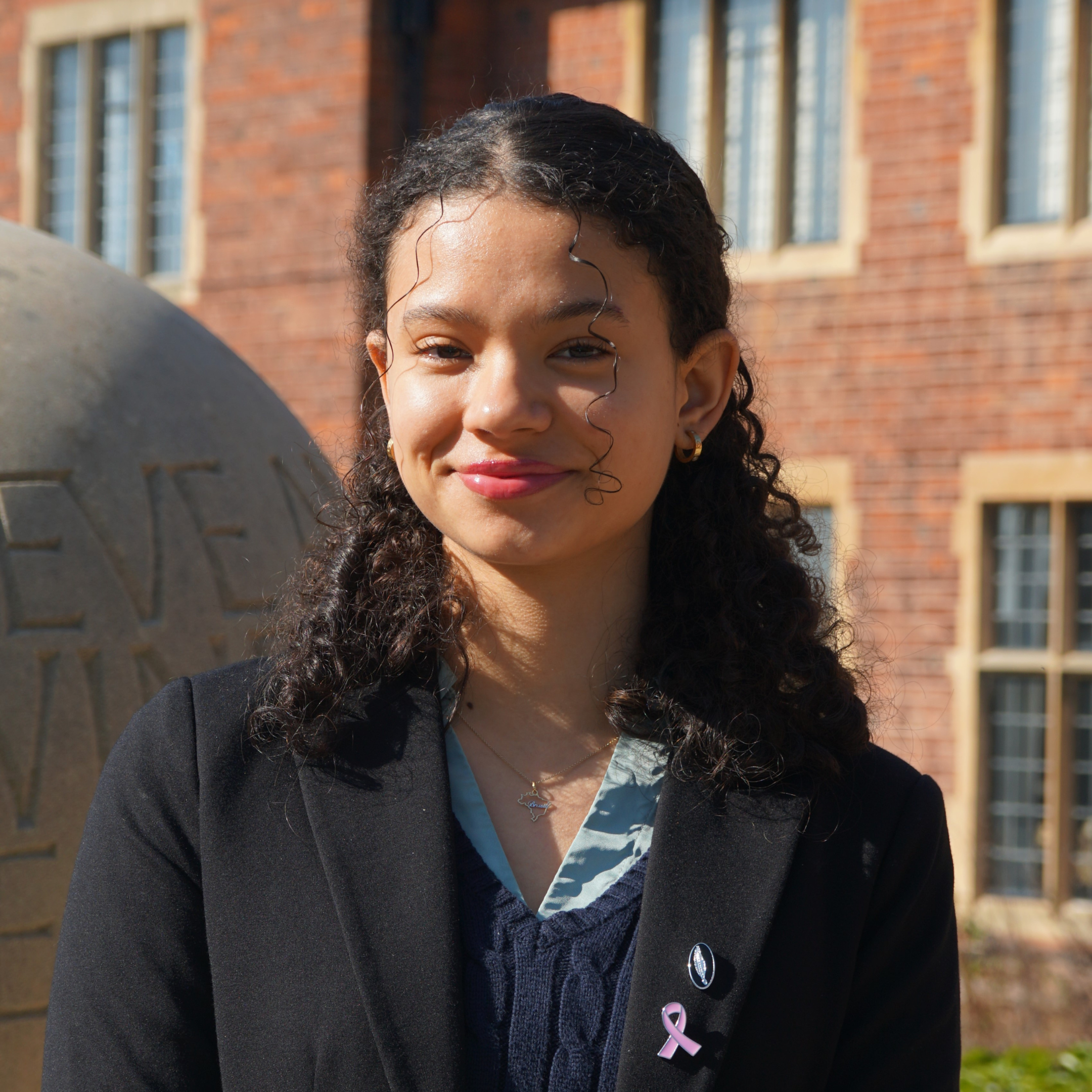
RADINA SLAVCHEVA
Bulgaria
What social justice movement gained attention through widespread social media presence?
"Don't cry, we have to be strong now," one woman said to another during the protest “Nito edna povetche” (Not one more) in front of the Sofia Court House on 31 July, 2023. After a while, their conversation is drowned out by the shouts of thousands of outraged people, all gathered to support the injured 18-year-old Debora Mihailova from Stara Zagora, Bulgaria. In the summertime of 2023, Debora was ruthlessly beaten and disfigured with a mock knife by her then ex-boyfriend, causing wounds that required her to have a total of 400 stitches. In addition, her nose was broken and all of her hair was shaved off in a reportedly vicious manner.
The 26-year-old suspect, identified by the media as Georgi Georgiev, was arrested after the attack, but a court in Stara Zagora later released him after rating the woman's injuries as "light." Amid public disapproval, Georgiev was rearrested on July 31 and the prosecutor's office announced that it was "accelerating" the investigation. He currently remains in custody, but what’s interesting is that Debora's case only became known to the public through reports on some of the major Bulgarian broadcast channels and widespread social media presence on platforms such as Instagram and Facebook, all showing horrendous images of Debora’s injured body.
Some of the well-known Bulgarian YouTubers invited the 18-year-old to discuss the case with Georgiev, the mental health issues she still faces after the assault, and her hope for a safe future for all women. Compared to other previous cases of violence against females in Bulgaria, Debora's case caused a larger public response, and many suggest that the reason for this is because the others died, but she managed to survive. This massive social justice movement even led to changes in the legislation against domestic violence in the Balkan EU member states.
The events surrounding the attack paved the way for numerous criticisms of how all the institutions in Bulgaria actually treated the case. “We are appalled that 400 stitches and a broken nose were filed as a ‘minor bodily injury’,” the Bulgarian Fund for Women said. “This only sends a message to all victims of abuse that the pain and horror that they experience could go unpunished,” it added.
The judge, who in June released Georgiev, Tatyana Gyoneva, said she made her decision because, according to the documents that were presented to the panel, it was a case of minor bodily harm. However, it was not clear why neither the Prosecutor's office nor the court had asked for an expert medical examination to determine what the injuries on the girl's body were and then make their final decision. After the powerful public reaction, however, she was asked if she found the abhorrent photos of Debora's assaulted body disturbing. She answered, "Of course, I felt disturbed, the whole panel of judges found them distrubing."
Furthermore numerous media asked Tatiana Gyoneva whether, in the face of this public reaction, she was considering resigning and leaving the judiciary world. "Thank you also for this question, thank you to everyone who supported me in this ordeal because my colleagues supported me and they know what kind of person I am, I am not bragging. I hope you reflect on our successes as well. I don't intend to, no. I love my job." Judge Gyoneva also did not respond to the question of why she had not considered two previous deliberations on bodily harm by offenders, and when asked if she would stand for the protest she said the following: "I think you're asking too much of me. I'm calling for a line that, if crossed, the damage would be very serious."
Further controversy has been sparked by photographs of the alleged perpetrator circulating on social media, showing tattoos with nationalist slogans. Even the writer Georgi Gospodinov, the first Bulgarian to win the International Booker Prize with his novel Time Shelter, commented on the case with the words: "Their patriotism - tattooed, their knives - mocked, their freedom - death." on Facebook.
“Thank you for supporting me, thinking about me, praying for me, and fighting with me in this very scary time for me,” Debora Mihailova said in a video message on Facebook, posted right after Bulgaria's parliament ultimately gathered in a session on August 7 and approved changes to the Criminal Code and the law on protection from domestic violence. The amendments provide for the right to protection for people who have experienced violence in the context of an intimate relationship or for victims of violence who are neither married to their potential abuser nor are they in a relationship.
Correspondingly, the creation of a National Information System for all cases of domestic violence with data on who the victims are, what violence was inflicted on them, what actions were taken, who are the responsible institutions is one of the 15 measures for the prevention of violence and aggression identified at the meeting in the Council of Ministers between Prime Minister Nikolay Denkov and the other representatives of the four ministries. "My feeling is that this was a hidden epidemic and many people, encouraged by the support of society and institutions, only now dared to talk about their specific problems," he commented. Among the adopted measures are an increase in the number of psychologists in schools and the development of a National Program for the Prevention of Violence, which will offers specialized services for adults and children.
And while Georgi Georgiev is being officially charged with three offenses for his assault, the young woman, despite the horrors she has endured, fearlessly displays her scars as an example to others. "I want to send my message to all women not to hide. We are beautiful," Debora said. "The people who supported me all over the country and my family, they helped me the most. Thanks to them, I'm back on my feet," Mihailova added.
Debora intends to help women who have also suffered violence in the future as she explained that many women who have been victims of violence have written to her and sometimes she is left speechless, not even able to answer or write anything. Nevertheless she is glad that women or girls do not remain silent because one should not remain silent.
When Debora made an Instagram account where she posted a photo of herself smiling, she received countless positive comments from users, who seemed to shower her with praise. Her media presence had only just begun though, as Mihailova stepped boldly on the music scene just a few months later. Her debut song happened thanks to the famous Bulgarian singer Galin, one of the first to reach out to Debora. After that the offers to the Mihailova began to come one after another with Dian Savov, better known as DJ Dian Solo, wrote to the young woman on behalf of the Deep Sound Project, offering her to record her original songs or covers in a professional music studio. "If doctors heal the body, then music heals the soul", he further explained.
As many other women decided to report domestic violence by filing reports or complaints, the behavior change among the individuals has been highlighted. In the first half of the year, 1,950 orders for immediate and permanent protection, issued by district courts, have been received in the National Police General Directorate - by 18% more compared to the previous year. There is also a 40% increase in the number of pre-trial proceedings initiated in the context of domestic violence. Zornitsa Shumanova, head of the newly created unit for domestic violence at the General Directorate of the National Police urged the victims not to hesitate and seek help from the competent authorities. "The more we talk, the more the crimes will not be latent," she concluded.
Although the institutional response to gender-based violence still remains largely ineffective in Bulgaria, with a deficit of crisis centers and coherent statistics about the scope of the problem, the fight for a world where women are not afraid to leave their homes and where offenders are brought to justice is only getting stronger. For Dr. Veselin Guerev, a psychiatrist, the significant increase in reports indicates that the civil society in Bulgaria is slowly, but surely “getting rid of fear”.
1st Place GLOBAL WINNERS 2025
-
![A woman with long, wavy brown hair smiling outdoors surrounded by greenery, wearing a pink lace dress.]()
journalistic
Elina Quito
Germany -
![A young boy with short dark hair smiling outdoors in a black shirt with a blurred green natural background.]()
Creative
Justin Yu
United States of America -
![A young man with dark hair smiling at the camera in a well-lit room.]()
argumentative
Zaeemah Mahmud Sarder
United States of America